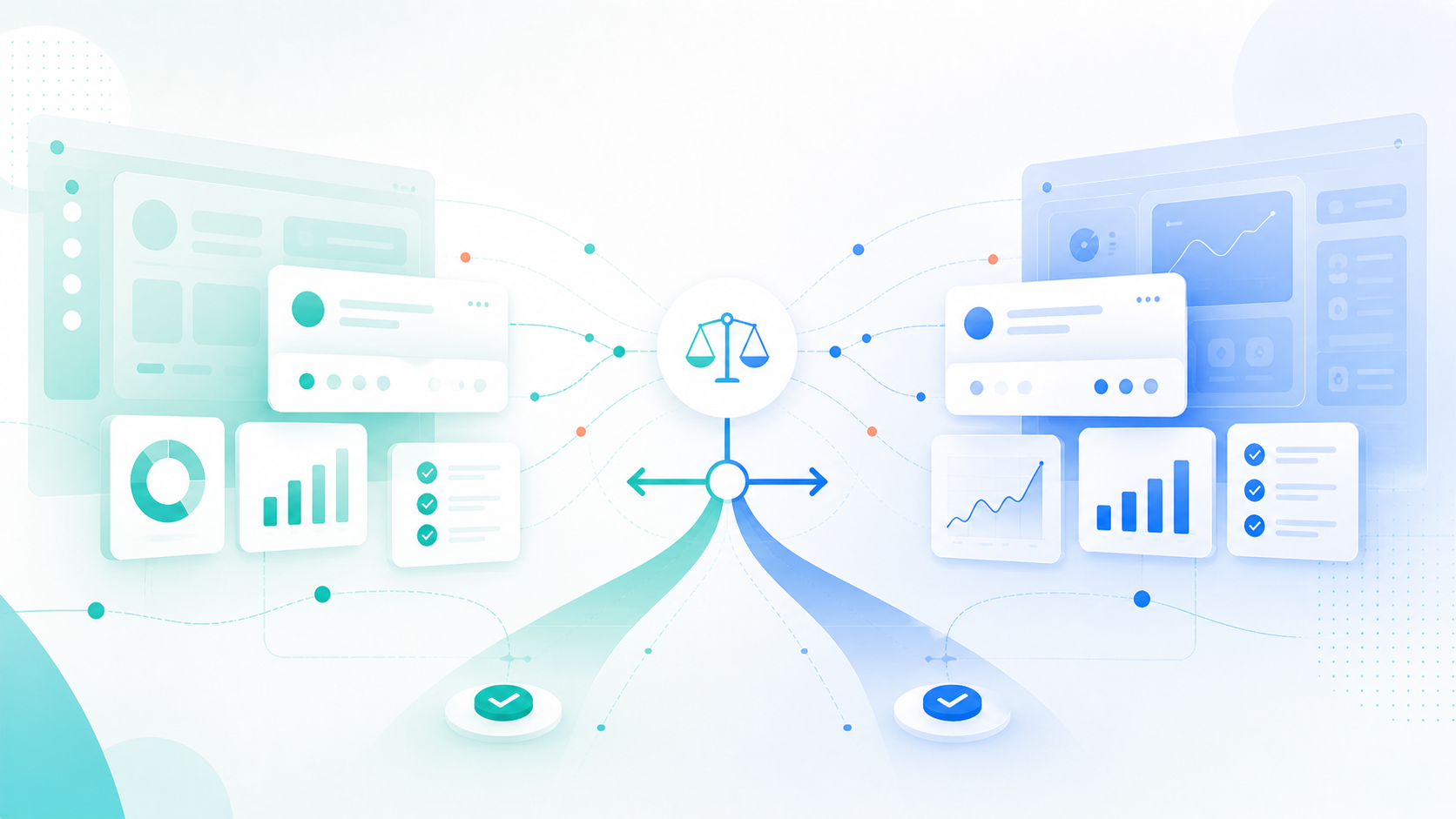
Salesforce Service Cloud and Oracle Service Cloud solve overlapping support problems, but the buying intent is different: this query is mostly about CRM-native enterprise service vs Oracle enterprise ecosystem. Choose the platform that matches your daily workflow first, then compare price, AI, integrations, reporting, and migration effort.
Table of contents
SERP and SEO findings for “salesforce vs oracle”
Search intent is a commercial investigation query. The top-ranking pages usually include a direct comparison, a quick verdict, a pricing section, feature tables, use-case guidance, FAQs, and internal links to product or comparison pages. For HelpDesk Picker, the opportunity is to go deeper than a vendor landing page while still keeping the answer fast and practical.
| SEO factor | Recommendation for this keyword |
|---|---|
| Primary intent | enterprise comparison |
| Target title pattern | Salesforce Service Cloud vs Oracle Service Cloud: pricing, features, AI, integrations, and best fit. |
| Suggested word count | 1,800–2,600 words for the blog page; 900–1,500 extra words on the comparison landing if it is thin. |
| Required schema | Article, BreadcrumbList, FAQPage. Avoid Product schema on comparison articles. |
| Internal links | Salesforce Service Cloud, Oracle Service Cloud, Salesforce Service Cloud vs Oracle Service Cloud, migration guide, AI helpdesk guide, and relevant best-for pages. |
| Content gap | Most competitors list features. Better pages explain when each product actually fits a support operation. |
- SERP has broad CRM comparison intent, so the article should explicitly narrow to Service Cloud / customer support use cases.
- Winning content should discuss ecosystem fit, implementation complexity, integration strategy, and migration risk.
- The article should link to the exact comparison page and both enterprise platform profiles.
Salesforce Service Cloud vs Oracle Service Cloud: quick verdict
Choose Salesforce Service Cloud if your team already works in a way that matches Salesforce Service Cloud's core product model and ecosystem. Choose Oracle Service Cloud if it better matches your support channels, team size, customer context, and implementation resources.
The safest decision is rarely based on one feature. It comes from matching the tool to your support maturity: simple inbox, structured ticketing, AI-assisted support, ITSM, ecommerce support, enterprise service, or MSP operations.
If two platforms look similar on paper, test them with five real workflows: a simple request, an escalation, a refund or account issue, a reporting task, and a migration sample.
Salesforce Service Cloud vs Oracle Service Cloud: comparison table
| Category | Salesforce Service Cloud | Oracle Service Cloud | What to check |
|---|---|---|---|
| Best fit | Teams aligned with the Salesforce Service Cloud operating model. | Teams aligned with the Oracle Service Cloud operating model. | Team size, support volume, customer type, and workflow maturity. |
| Pricing | Check plan limits, add-ons, and AI costs. | Check plan limits, add-ons, and AI costs. | Total cost over 12 months, not just starter price. |
| AI | Evaluate triage, summaries, response help, and automation. | Evaluate triage, summaries, response help, and automation. | Use your own tickets and knowledge base for testing. |
| Integrations | Works best when your stack already connects well. | Works best when your stack already connects well. | CRM, ecommerce, ITSM, product, billing, and BI tools. |
| Reporting | Good if built-in reports answer leadership questions. | Good if built-in reports answer leadership questions. | SLA, queue, agent, customer, AI, and channel metrics. |
| Migration | Requires field and workflow mapping. | Requires field and workflow mapping. | Tickets, users, companies, comments, attachments, tags, and KB. |
Pricing and total cost
Pricing pages rarely tell the full story. For Salesforce Service Cloud vs Oracle Service Cloud, compare the cost of seats, AI, phone or messaging, reporting, admin permissions, support package, implementation, integrations, and migration. A cheaper plan can become expensive if it requires workarounds, extra apps, or manual reporting.
Build a 12-month model with the number of agents, expected channels, AI usage, support volume, required integrations, and the cost of setup. For ITSM and enterprise tools, include implementation and admin time. For messaging-first tools, include AI resolution or usage-based pricing where applicable.
AI and automation
Do not choose based on AI marketing alone. Test classification, summarization, suggested replies, agent assist, knowledge base retrieval, routing, escalation, and reporting. The platform that looks more advanced in a demo may still be weaker if your knowledge base is messy or your workflows are not ready.
Automation should reduce agent work without hiding operational complexity. Check whether rules are easy to maintain, whether they support your customer segments, and whether reporting can prove the automation actually improves resolution time or quality.
Ticketing, service workflows, and reporting
Compare how each platform handles incoming requests, assignments, internal notes, customer history, SLAs, escalations, and cross-team collaboration. For customer support, look at omnichannel context and help center quality. For ITSM, look at incidents, service requests, change, assets, and approvals. For ecommerce, look at order context, refunds, returns, and shipping workflows.
Reporting is often the deciding factor. Make sure managers can answer basic questions without spreadsheet work: which channels create the most load, which automations help, where SLAs fail, which customers need escalation, and what historical data must survive migration.
Integrations and ecosystem
Before choosing, list your must-have integrations. Common checks include Salesforce, HubSpot, Shopify, Jira, Slack, Microsoft Teams, telephony, billing, data warehouse, analytics, and identity providers. Native integration quality matters more than marketplace quantity.
Open the platform profiles for more context: Salesforce Service Cloud review and Oracle Service Cloud review. For the direct side-by-side view, use Salesforce Service Cloud vs Oracle Service Cloud.
Migration checklist
Migration should be planned before the contract is signed. Review what data needs to move, what should be archived, and what should be redesigned. The most common migration scope includes tickets, contacts, companies, agents, groups, comments, private notes, attachments, custom fields, tags, priorities, statuses, satisfaction ratings, and knowledge base articles.
Use a test migration before the final cutover. Validate field mapping, ticket counts, attachments, customer visibility, private notes, and reporting. If you are changing workflows, rebuild automations intentionally instead of copying old logic into the new platform.
FAQ: Salesforce Service Cloud vs Oracle Service Cloud
Which is better, Salesforce Service Cloud or Oracle Service Cloud?
It depends on your workflow. Salesforce Service Cloud may be better for teams that match its operating model, while Oracle Service Cloud may be better if its ecosystem, channels, pricing, or implementation style fits your team more closely.
Which platform is cheaper?
Compare the full 12-month cost, including agents, AI add-ons, usage pricing, reporting, phone or messaging, implementation, integrations, and migration.
Which platform is better for AI?
Test AI on your own tickets and knowledge base. Look at triage, summaries, suggested replies, routing, handoff quality, and reporting.
Can I migrate from Salesforce Service Cloud to Oracle Service Cloud?
In many cases, yes. Migration scope depends on API access, ticket history, comments, attachments, users, companies, custom fields, knowledge base content, and platform limitations.